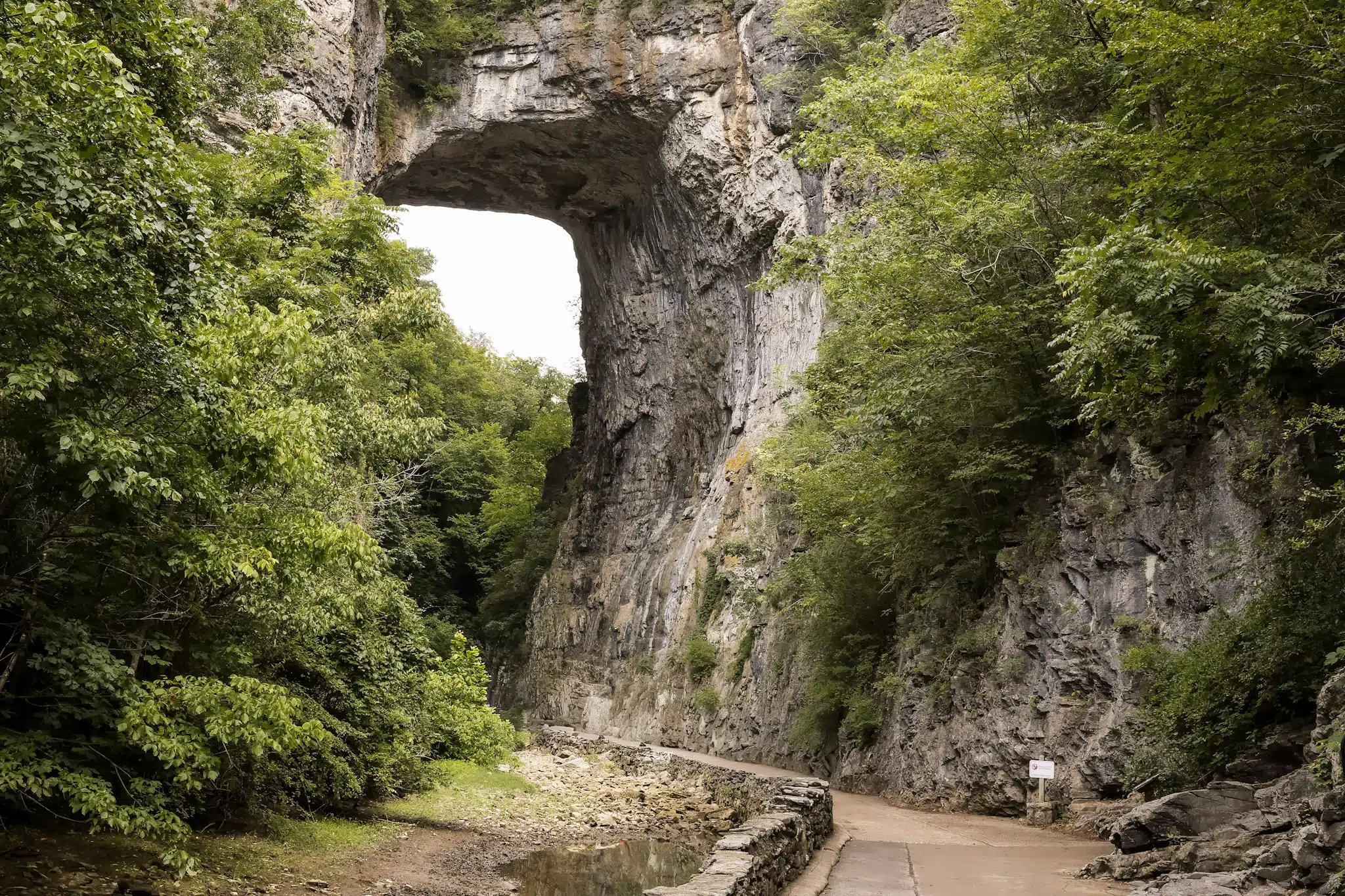
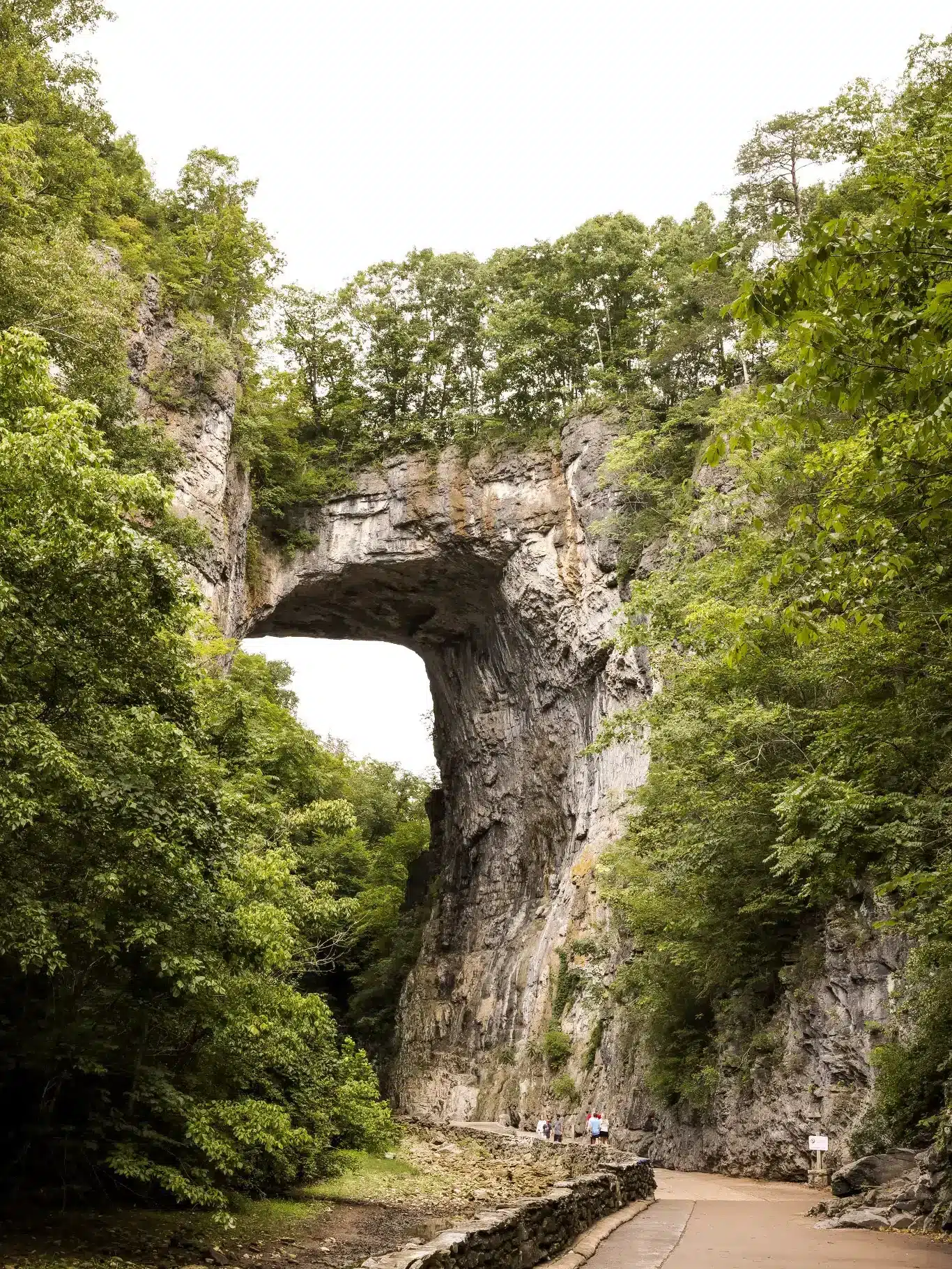
We spent a week traveling through the Shenandoah Valley, and Natural Bridge State Park was one of the stops we planned the whole southern leg around. Standing underneath the 215-foot arch — Cedar Creek running quietly below, the gorge walls rising on either side — you understand why this place has held people’s attention for centuries.
Thomas Jefferson purchased the land in 1774 for 20 shillings and called it “the most sublime of Nature’s works.” He wasn’t wrong. Natural Bridge State Park sits in Rockbridge County, Virginia, about 3 hours from Washington, DC, and it earns every mile of the drive.
What You’re Actually Looking At
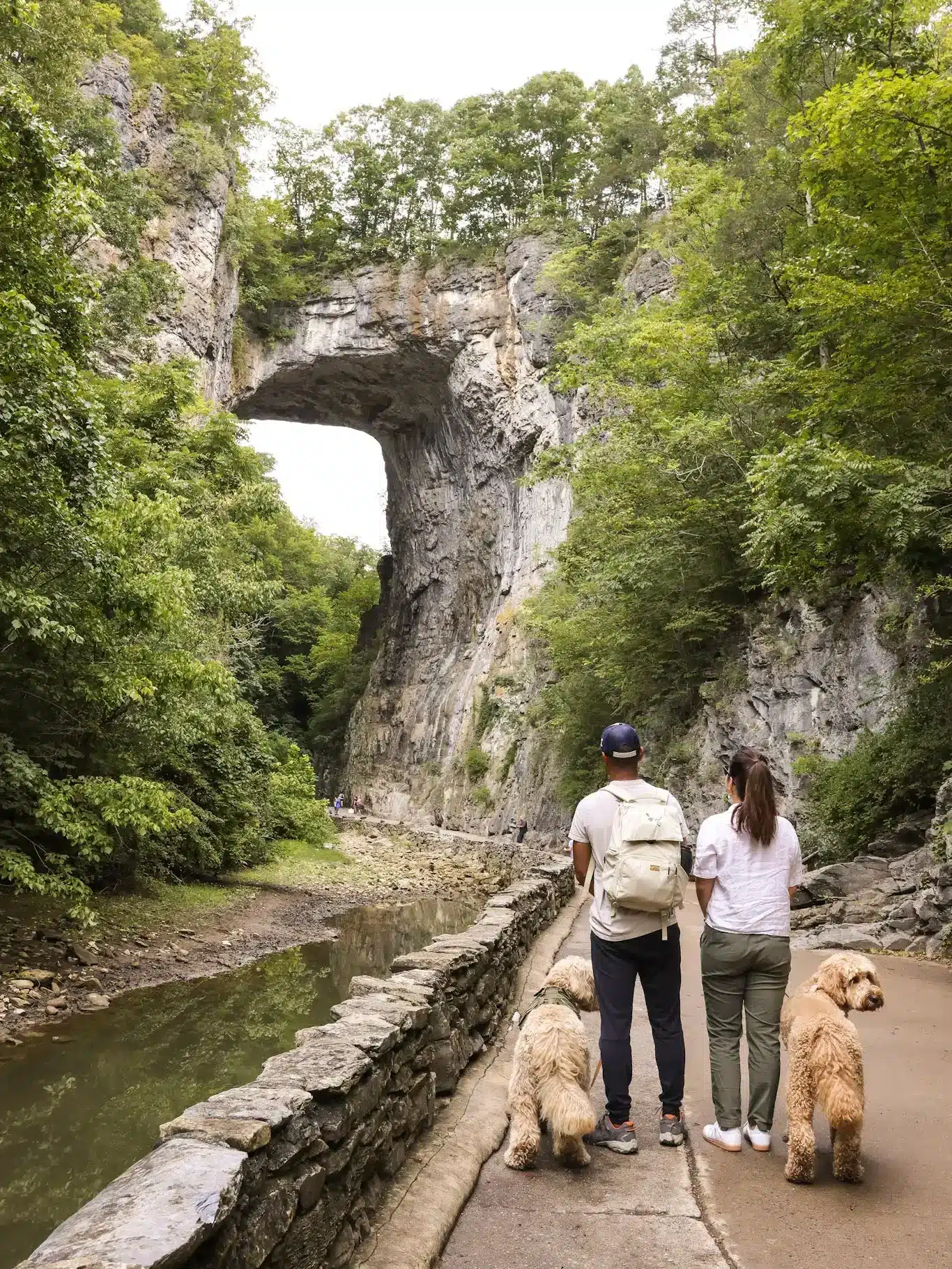
Natural Bridge is a karst formation — the same geologic process that carved Ha Long Bay in Vietnam, the limestone towers of Guilin and Yangshuo in China, and the cenotes of Mexico’s Yucatan Peninsula. Slightly acidic water slowly dissolves limestone over millions of years, leaving harder rock standing where the rest has worn away. What remains here is a 215-foot arch, 90 feet wide, shaped by Cedar Creek over an almost incomprehensible stretch of time.
It’s a reminder that some of the world’s most dramatic natural landscapes share the same origin story — and that Virginia has one of its own, quieter and less traveled than most.
The History
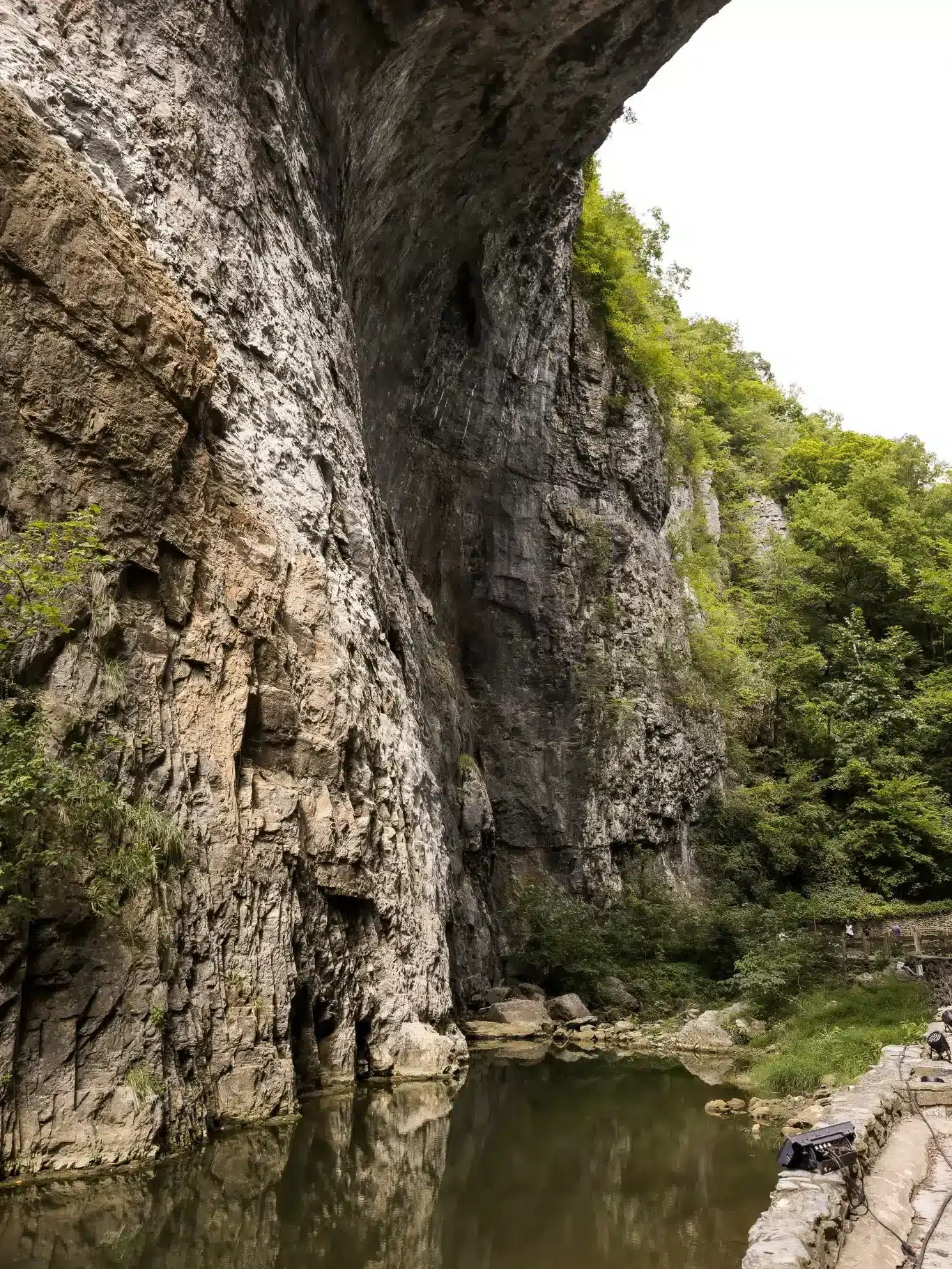
Long before Jefferson, long before European contact, the Monacan Indian Nation considered Natural Bridge a sacred site. They called it the “Great Path” — a ceremonial crossing, a spiritual landmark, a place woven into their oral tradition and seasonal travel routes. According to Monacan oral history, the arch appeared as an act of divine intervention in a moment of great peril and became central to their cultural and ceremonial life. The Monacan Indian Village on Cedar Creek Trail is a living history site where interpreters share that history directly.
George Washington surveyed the bridge as a young man. He reportedly carved his initials into the rock wall. Look for GW as you pass through the gorge.
Jefferson purchased the 157-acre property from King George III in 1774. He built a cabin nearby and hosted guests under the arch, describing it repeatedly as one of nature’s greatest works. The bridge then passed through private hands for well over a century, operating as a tourist attraction from 1882 through 2014.
In September 2016, Natural Bridge was designated Virginia’s 37th state park, and simultaneously recognized as an Affiliated Area of the National Park Service. It had been designated a National Historic Landmark in 1998. It is also, notably, the only Virginia State Park on privately owned land.
The Trail
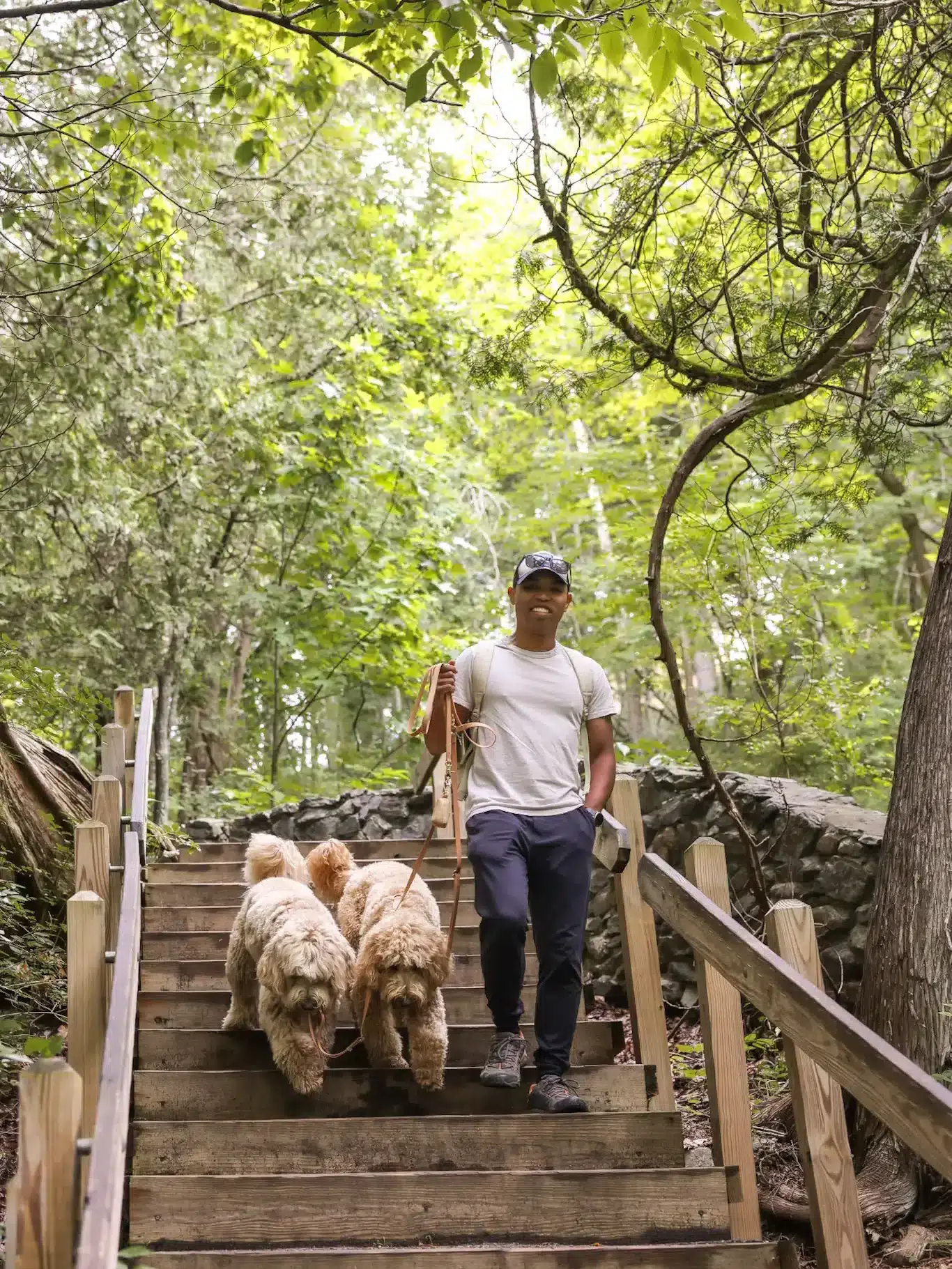
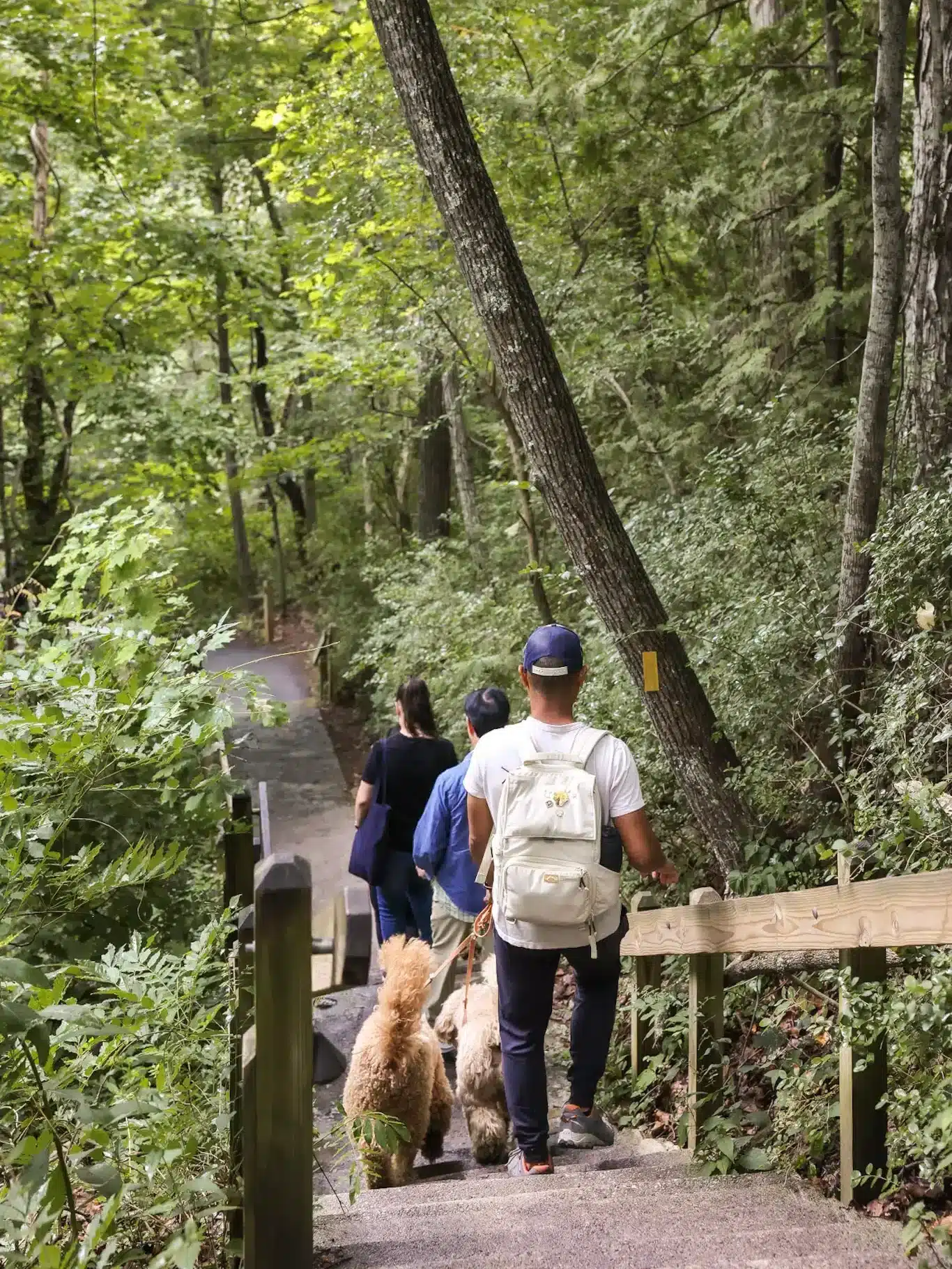
Cedar Creek Trail is 1.6 miles out-and-back, mostly flat and paved, beginning with a 137-step descent alongside a small, moss-covered waterfall. The arch appears early. Before you reach it, there are benches on both sides of the bridge — one with a view looking up at the arch from the approach, one on the far side looking back from downstream. Worth pausing at both. The two angles are completely different, and both are worth sitting with for a few minutes.
From there the trail continues past the Monacan Indian Village, the Salt Peter Mine, and the Lost River before ending at Lace Falls, a 30-foot cascading waterfall. The whole out-and-back is manageable in 45 minutes to an hour at an easy pace, longer if you stop at the village. At the bottom of the stairs, Cedar Creek Cafe serves food and drink, or you can bring your own. The benches along the creek make for a genuinely pleasant informal picnic spot, before or after the arch.
We went on a July morning under overcast skies with a chance of rain, and it was perfect. The diffused light brought out the colors of the limestone, the moss, and the creek in a way that direct sun wouldn’t have. The canyon is deeply shaded regardless, but overcast conditions are genuinely ideal here. No blown highlights, no harsh shadows, just even light across the full height of the arch.
Three additional trails are accessible from separate parking areas nearby: the Blue Ridge Trail (3.3-mile loop), the Buck Hill Trail (1.8 miles), and the Skyline Trail (0.6 miles to Jefferson Point). These trailhead parking areas charge $5 per vehicle.
Inside the Rockbridge Center
The Rockbridge Center is dog-friendly; Truffles and Chai were welcome inside, which isn’t something you can say about most visitor centers. Inside you’ll find exhibits on the geology and history of the bridge, the Cedar Creek Cafe, and a gift shop.
If you’re doing a full day, the Rockbridge Center is a comfortable place to land before or after the trail — air-conditioned, interesting, and more than just a lobby.
Admission
Admission is $9 per person for ages 13 and up, $6 for ages 6–12, and free for children under 6. The Virginia State Parks annual pass covers admission. Parking is free.
Worth flagging: most Virginia State Parks charge per vehicle. Natural Bridge is the exception — admission is per person, so factor that in when planning for a larger group. Keep your ticket after purchase because it’s scanned at the trail entry point before you descend the stairs.
The visitor center is open 10:00 am to 6:00 pm from March through November. The park opens at 8:00 am and closes at dusk.
Dog Policy
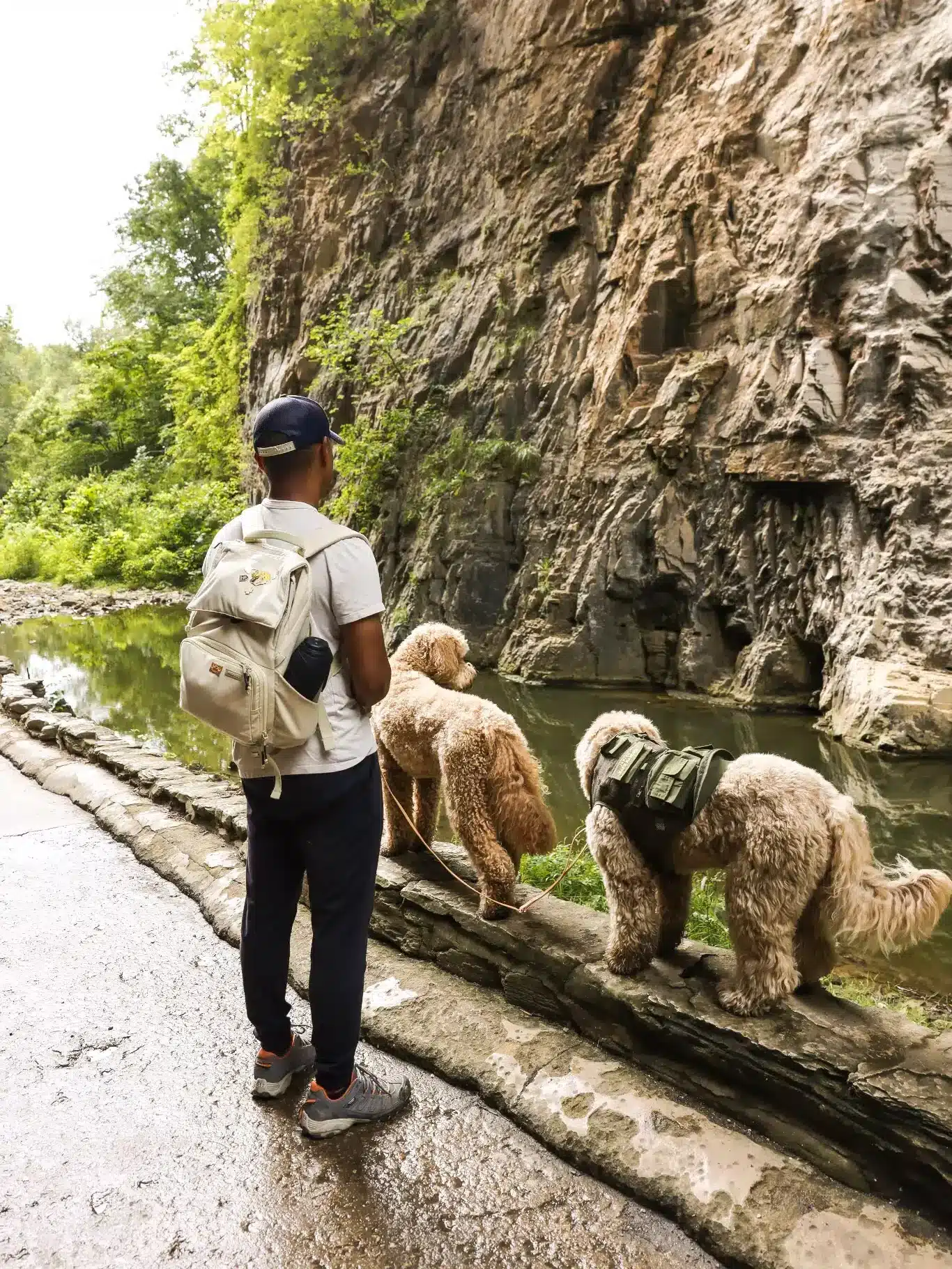
Leashed dogs are welcome on all trails and inside the Rockbridge Center. The leash must be 6 feet or shorter. The 137 stairs at the start are manageable for most dogs but worth thinking through for senior dogs or those with joint issues.
🐾 Find: Natural Bridge is the only park we’ve found B.A.R.K. Ranger vests at affordable prices, available at both gift shops (the Rockbridge Center and the Trail Store before trail entry). Largest size is XL.
🌿 Leave No Trace: Pack out what you pack in, stay on the trail, and keep your dog from disturbing the creek and its surroundings. The gorge is a living ecosystem, so help keep it that way.
Photography
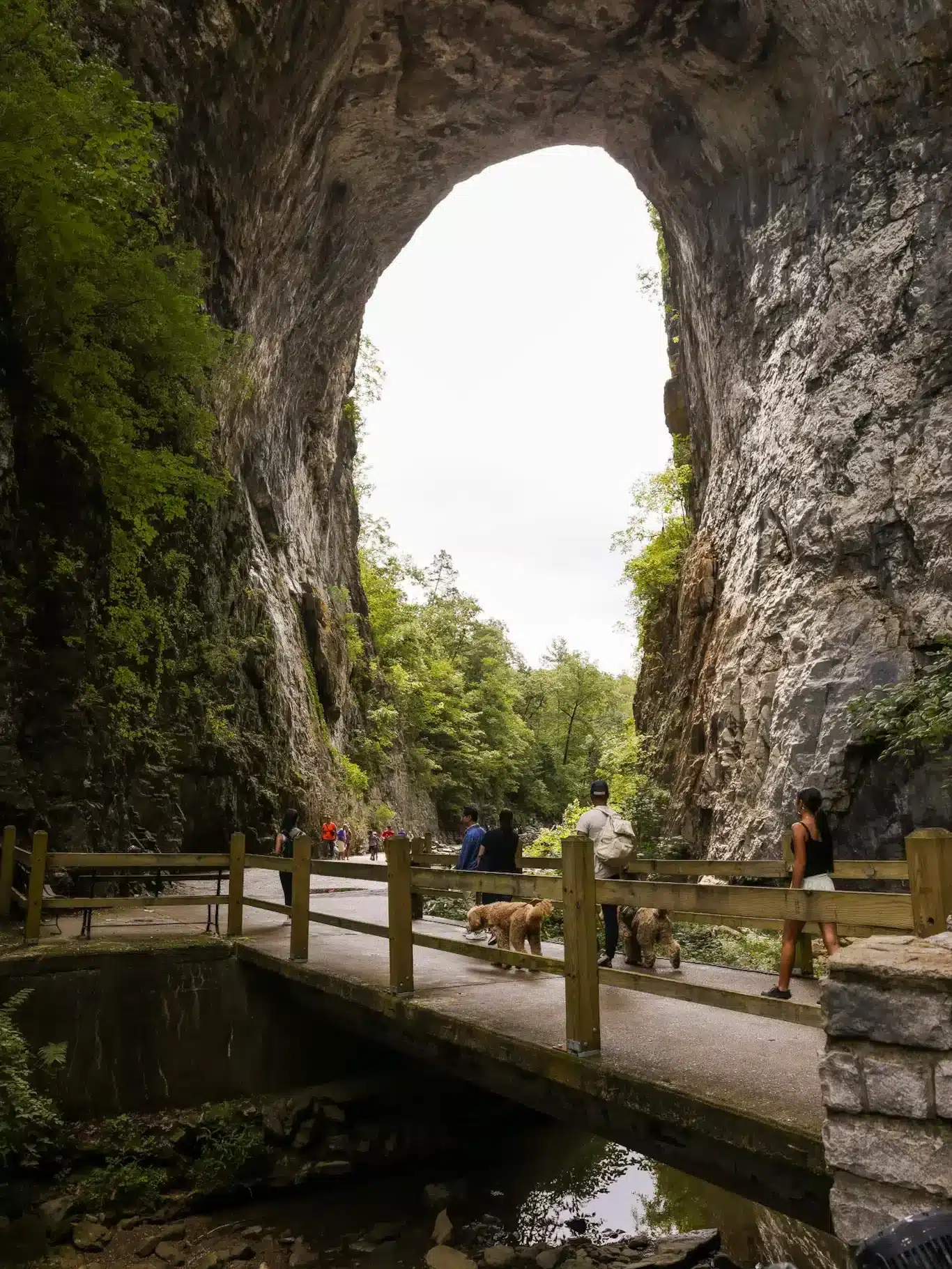
The shot everyone wants is from the creek bed directly below the arch, wide angle pointed straight up. It works best when you’re past the bridge, walk a few steps downstream, turn around, and shoot back toward the arch with the creek as your foreground. Overcast light keeps the exposure even across the full height of the arch. In direct sun, the sky blows out, or the gorge goes dark — a polarizer helps but doesn’t fully solve it.
If you’re visiting in summer, morning is the move with cooler temperatures and, if you get overcast skies, the colors in the gorge are exceptional. Overcast light is genuinely your friend here.
For a composition with more context, the bench on the downstream side of the arch gives a natural framing with the creek, the arch, and the gorge walls in a single frame. It’s a quieter shot than the straight-up angle and often more interesting.
If You Go
Natural Bridge sits at the center of a genuinely rich stretch of Rockbridge County. It’s 20 minutes from Downtown Lexington — one of the most charming small towns in Virginia, with dog-friendly restaurants, the Chessie Nature Trail along the Maury River, and Washington & Lee University all within walking distance. Goshen Pass, with its clear mountain swimming holes along the Maury River gorge, is 30 minutes north. Ecco Adesso Vineyards, a 350-acre farm stay with award-winning estate wines and dogs welcome throughout the entire property, is 15 minutes away.
If you’re making the drive from DC — about 3 hours via I-81 south — Rockbridge County rewards a long weekend. Natural Bridge is the anchor, but it’s far from the only reason to come.
The area around Natural Bridge is a certified International Dark Sky Park, so if you’re staying nearby, the night skies over Rockbridge County are worth setting an alarm for.
For more on the full Rockbridge County and Shenandoah Valley road trip, our Shenandoah Valley Dog-Friendly Road Trip Guide is coming soon.